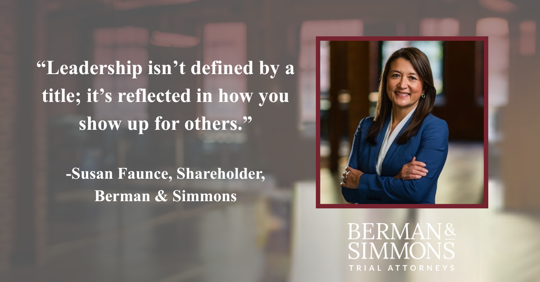
Berman & Simmons trial attorney and shareholder Susan A. Faunce was recently featured in Authority Magazine as part of its ongoing series on increasing women’s engagement in leadership and management roles. The series highlights accomplished women leaders who have navigated barriers to advancement and are shaping the future through advocacy, mentorship, and service.
In her interview, Susan reflects on her personal journey, her approach to leadership, and the values that guide her work representing clients in high-stakes medical malpractice, wrongful death, and complex personal injury cases.
Read the full interview on Authority Magazine →
A Calling Rooted in Advocacy
Susan knew she wanted to become a lawyer at a young age. Born in Korea and raised in a military family, she moved to the United States as a child and eventually settled in Maine. When her parents divorced, Susan often acted as her mother’s translator in legal settings, an experience that left a lasting impression.
She recalls watching the female attorney who represented her mother in court, noting the confidence and authority she brought to the room and the way she gave Susan’s mother a voice. That moment helped shape Susan’s vision of what the law could do for people who otherwise feel powerless.
After earning her undergraduate degree from Bowdoin College, Susan served as a paralegal on high-profile intellectual property matters in Boston and later joined the Peace Corps, teaching English and French in Morocco. She returned to Maine for law school at the University of Maine School of Law, clerked for the Honorable John Beliveau, and joined the bar in 2006.
Finding Purpose in Trial Work
While Susan initially considered family law, a trial opportunity during law school revealed her aptitude and passion for courtroom advocacy. That experience ultimately led her to Berman & Simmons, where she found alignment between her values and the firm’s mission to represent people facing serious harm and injustice.
Early in her career, Susan was often one of the only women in the room and encountered assumptions about her role. Over time, she learned to stop conforming to expectations and instead lead with confidence, authenticity, and command of the facts. Her experience mirrors broader changes in the legal profession and underscores the importance of representation and inclusion.
Leadership Beyond Titles
In the interview, Susan emphasizes that leadership is not defined by position or title, but by how one shows up for others. Her leadership philosophy extends across her legal practice and her service to the profession.
As President of the Maine State Bar Association, Susan has focused on strengthening collaboration within the legal community and expanding access to justice, particularly in rural areas. She has also been a strong advocate for women in the profession, co-chairing the Women’s Law Section and helping lead initiatives that addressed gender-based compensation disparities.
That same leadership mindset informs her approach to representing clients, particularly in medical malpractice cases involving women whose concerns were dismissed or misdiagnosed. Susan views her role as helping clients reclaim their voice, dignity, and sense of control after life-altering harm.
Mentorship, Resilience, and Paying It Forward
Susan credits several women with shaping her path, including her mother, mentors from the Upward Bound program, law professors, and fellow attorneys. One pivotal piece of advice she received early on was to negotiate her salary, guidance she now shares widely with women entering the profession.
When asked about a guiding principle, Susan points to a quote by Maya Angelou: “You may not control all events that happen to you, but you can decide not to be reduced by them.” The sentiment reflects both her personal background and her professional approach to overcoming obstacles with resilience and creativity.
Looking Ahead
Despite progress, Susan acknowledges that women remain underrepresented in leadership roles across industries. In her view, meaningful change requires workplace policies that support balance, as well as stronger community and institutional support systems. The expectation that women can “do it all” without structural support, she notes, is neither realistic nor sustainable.
Through her legal work, leadership roles, and advocacy, Susan continues to advance a more inclusive profession while holding negligent parties accountable and fighting for justice on behalf of her clients.
To read Susan’s full interview and insights on advancing women in leadership, visit Authority Magazine.